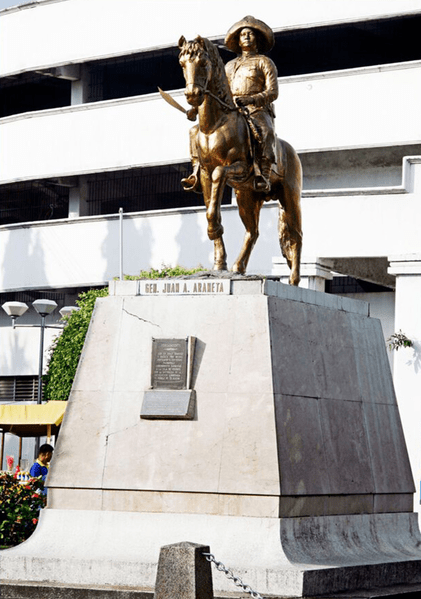
Gen. Juan Araneta played a pivotal role in the historic Negros Revolution of 1898. Celebrated in Negros Occidental today as Cinco de Noviembre, the intrepid revolt led to the surrender of the Spanish Governor in the province.
Bagonhon are the people live in Bago City. We believe that Gen. Juan Araneta is the hero of the city because of his contributions. By on the history of the Heritage at the Heart of Bago. A sugar baron by trade, Juan Araneta travelled to Europe to buy farm equipment that he intended to use in his sugar plantation. The equipment, shipped in crates, roused the suspicion of Spanish authorities and convinced them that he was stocking up on arms. On the fateful day of November 5, 1898, Gen. Araneta, together with his cousin-in-law Gen. Aniceto Lacson, led thousands of farm workers from Bago to Bacolod carrying makeshift cannons and rifles to intimidate the Spanish army. Believing that they were outnumbered and outgunned, the Spaniards eventually surrendered.
“It was then that they discovered he had only three rifles and a pistol,” says Clem del Castillo, grandson of Gen. Araneta. “Of course, everybody had a bolo and a machete…but that’s it. He bluffed the Spaniards, thinking they could not really fight the revolutionaries.”
Gen. Araneta later served as the Secretary of War of the short-lived Cantonal Republic of Negros. In 1906, eight years after the Negros Revolution, he assumed ownership of the poblacion (town center) mansion given to him by his aunt, Natividad Sitchon Palacios. It is said that he accepted the generous gift wholeheartedly as he preferred the convenience of living in the poblacion rather than in his farm.
Balay ni Tan Juan is a typical bahay-na-bato architecture with the ground floor built of coral stone and the second floor made from the best hardwood found in the area. What is unusual though is that aside from being a granary, the ground floor also functioned as a living area as four of the eight bedrooms can be found here.
“I always remember him telling me that this is a memorable place for them,” recalls the general’s granddaughter Emilie Araneta de Ramos. “This serves as a meeting place for them at night where they can be together as a family,”.
Upon entering the mansion, one will immediately notice the majestic concave staircase. An outstanding feature unique to the house, the staircase leads to the second floor where one will find the huge sala, dining room, and the rest of the bedrooms. Tall Capiz windows and ventanillas (foot windows embellished in ironworks) surround the second floor. Ventanillas allow cool air from outside to enter and circulate in the house. Gen. Araneta spent the rest of his days at the mansion, remaining an influential figure in Bago up until his death in 1924.
Balay ni Tan Juan was transformed yet again. Now called the General Juan Araneta Residence and Landmark Museum, the house not only keeps stories of its past owners, but has also become a cultural treasure trove of Bago. At the ground floor, one area has been converted into a community museum whose main attraction is the Kabuhi sa Bago (Life in Bago) Exhibit.
“We have artifacts from the barangays,” shares del Castillo who curates and manages the museum. He recalls that he and his staff visited several barangays to talk about how people can learn and benefit from museums. “So, they donated a lot of things here,”
His contributions are serve as inspiration of many Bagonhon. We learned a lot from him especially being a strong man, Liberality and love for the town and even in the country.
~For Educational Purposes Only #WeBreakNewsNotHearts #BACOMMunity
 Jessie Cortez Ayungon